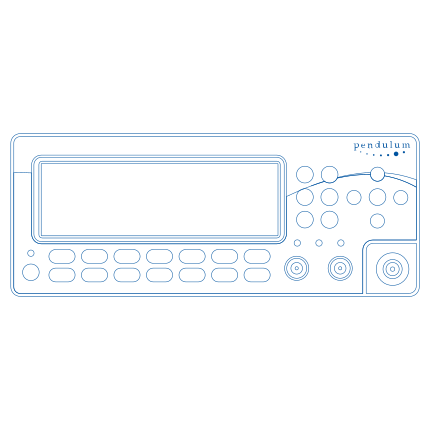
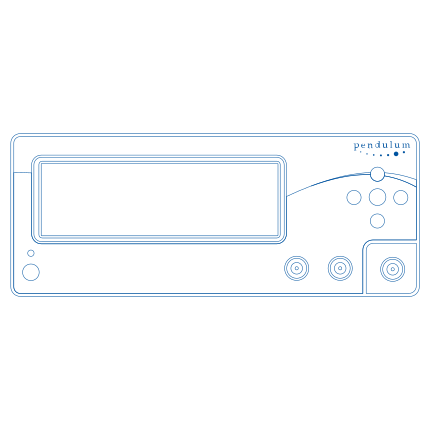
Pendulum Instruments introduces a budget 2-channel Frequency Counter/Analyzer
07.03.2024
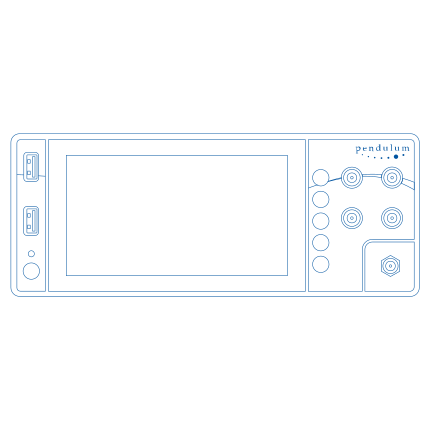
Pendulum Instruments, the global expert in time & frequency measurement, analysis, and calibration, announces today the release of the new CNT-102 Multi-channel Frequency Analyzer.
The CNT-102 is the second member of the recently introduced Multi-channel Frequency Analyzer family, offering the world’s first 2-channel UFC (Universal Frequency Counter), with parallel independent
Pendulum webshop
18.01.2024
We are excited to inform you that the Pendulum Instruments Web shop has been launched. We made a significant decision to open an online shopping platform as we see the growing importance of digital presence in the global market and would like to expand the Pendulum brand internationally. Pendulum Instruments Webshop will operate globally in all the regions not subject to political s
ITM/PTTI 2024 Long Beach, California, January 22-25, 2024
14.12.2023
Pendulum Instruments will be exhibiting at the Institute of Navigation’s ITM/PTTI 2024 taking place January 22–25, 2024 at the Hyatt Regency Long Beach in Long Beach, California. We’re pleased to be participating in ITM/PTTI 2024 for the fourth consecutive year. Visit our team at booth #11 – to network with us and learn more about Pendulum solutions for advanced timing analy
Honored by 2023 MAE Innovators Awards
25.10.2023
Pendulum Instruments is proud to announce that its CNT-104S Multi-channel Frequency Analyzer was recognized among the best by the 2023 MAEInnovators Awards. Votes placed by the engineering community recognized PendulumInstruments as a Gold in the Military + Aerospace Electronics Innovators Category.The 2023 MAE Innovators Awards celebrates outstanding innovation in defense and aer
ITSF 2023, 30 October - 2 November, Antwerp, Belgium. Booth: 18
Pendulum Instruments will be attending the 2023 International Timing and Sync Forum.
ITSF is the largest conference in the world which focuses on time and synchronisation gathering the global industry together for three days packed with critical discussion, unrivalled industry networking, world-class speakers and a cutting-edge exhibition. Come to booth #18 to meet our team and seize the oppor
EuMW 2023 17 – 22 September Berlin, Germany Booth:457C
The 26th edition of European Microwave Week will come to Berlin. The annual European Microwave Exhibition, which is by far the largest RF and microwave trade show in Europe, is held in conjunction with the conferences. The exhibition also includes a series of technical seminars and exhibitor workshops describing commercial products and processes. In addition, EuMW 2023 includes the Forum on Def
EMC Europe 2023 4-8 September Cracow, Poland Booth: T21
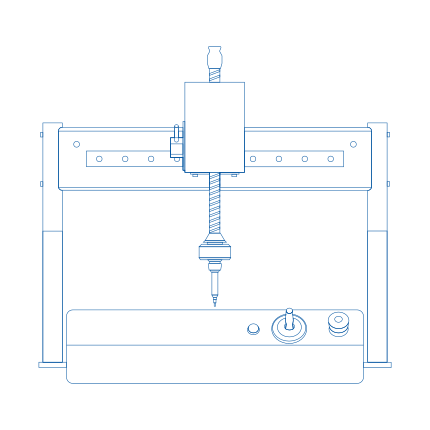
Pendulum is going to take part in EMC Europe 2023. It is the International Symposium on Electromagnetic Compatibility which is organized every year in one prominent city in Europe. In 2023 it is time for Cracow, Poland. We are going to showcase Detectus SCN EMC scanners for detecting EMC hotspots in your designs.
General Information
IEEE IFCS-EFTF 2023, 15-19 May, Toyama, Japan
Pendulum Instruments will be attending the 2023 Joint Conference of the IEEE International Frequency Control Symposium & European Frequency and Time Forum will be held in conjunction with the Asia-Pacific workshop on Time and Frequency in Toyama, Japan.
Visit our team at booth #3-5 and do not miss a chance to see and learn more about NEW CNT-104S Multi-Channel Frequency Analyzer.
To lear
EMV 2023 Booth C2-221 March 28-30, Stuttgart Germany
PendulumInstruments will be exhibiting at EMV 2023, the trade fair and workshops, in Stuttgart from 28 – 30 March 2023. This event is Europe’s leading platform for electromagnetic compatibility. We are going to present Detectus EMC scanner SCN-500 series, our powerful pre-compliance system for detecting EMC hotspots in your designs. You will also have a chance to talk about other products fro
ITM/PTTI 2022 23-26 January 2023, Long Beach, California
01.12.2022
We’re pleased to announce that will be exhibiting at the upcoming Institute of Navigation ITM/PTTI 2023 meeting taking place January 23–26, 2023 at the Hyatt Regency Long Beach in Long Beach, California.
The Precise Time and Time Interval Systems and Applications (PTTI) meeting is an annual conference sponsored by ION with a technical program designed to: disseminate and co